

In democratic Hindustan, with a population of 1.5 billion, elections are like a festival. With enthusiasm, excitement, and a sense of responsibility, this festival strengthens democracy election after election. But when the elections are in the Hindi-belt states especially Bihar and Uttar Pradesh the attention is not only of the entire country, but of the whole world. Complex caste equations, a sense of nationalism, and deep religious faith all influence the mood of the voters. In such circumstances, making accurate predictions in election surveys or exit polls becomes challenging for both journalists and analysts.
In the 2025 Bihar Assembly elections, most journalists and survey agencies failed to deal with this challenge effectively, and their predictions were nowhere close to the actual results. However, there are some journalists who handled this complex situation with ease and presented accurate predictions along with detailed data. The conviction and logic with which they made their predictions is incredible. Such a level of conviction can come only from journalists who have truly walked the ground who have stepped beyond party narratives, assessed public mood through their own experience, and made figures public only after testing them against that experience. His name is included among the veteran TV journalists of the country; knowledge of the political ongoings along the Hindi belt comes as naturally to him as breathing, and he can predict election results with near-perfect accuracy.
It is not uncommon for people to make predictions about wins or losses, but to make astute predictions about the share of seats for each coalition and its constituent parties is very rare; and Mukesh Kumar Ji is one of these rare journalists. In conversation with the man who forecasts political winds like second nature, Downtown Mirror spoke to one such veteran TV journalist Mukesh Kumar ji, Group Editor of Sadhna Media Group. Presented here are key excerpts from that conversation.
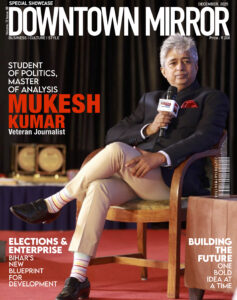
Downtown Mirror. Mr. Mukesh, throughout the Bihar Vidhan Sabha Elections 2025, your observations went against what most psephologists were saying, and in the end, it was your prediction that proved to be true. One might even say that you were more confident in these results than NDA leaders themselves. What instruments did you use to make these claims?
Mukesh Kumar. I do not possess any special instruments, and to my knowledge, neither does any other journalist. Because if that were the case, then every prediction would be the same. Jokes aside, the only useful instrument in psephology is to work at the grass-roots level, to talk to people of the region, and to study the demography of the electoral constituencies. In doing this, you develop a knack for understanding the nuances of what the voters tell you – their problems, their trust (or, lack thereof) in their representatives, as well as all the things they leave unsaid, because most people are not likely to tell you exactly what they feel. Any prediction made without accounting for these nuances is bound to fail. A good way to engage the people is to talk to them in the capacity of a contemporary, instead of as a reporter. This is where most surveys and exit polls go wrong; they rely on prepared questionnaires, the answers to which cannot be verified, and thus make inaccurate predictions. When you interview a voter, they may evade your questions, but when you converse with them as a fellow citizen, they are more likely to feel comfortable in sharing their opinion. Combining these honest testimonies with your journalistic experience can help you arrive at a sound conclusion. However, to engage in such meaningful dialogue, you need to be well-versed with every aspect of the Vidhan Sabha; what is the government doing for the region? Where did it fail to deliver its promises? Moreover you need the patience to listen to everything the voter has to say.
Downtown Mirror. But who possesses this much patience? We live in a fast-moving world, where everyone is in a hurry to get instantaneous results. If the polling closes by 6 PM, people want the election results the very next moment. Would it be accurate to say that this impatience of the people creates a pressure on the survey agencies and impacts their accuracy?
Mukesh Kumar. This is a great observation. There is a certain amount of pressure on the agencies to provide instant information. Some agencies succumb to this pressure and start dialling numbers from their Delhi offices, nowhere close to the polling booths.Their guesswork based on telephonic communication sometimes proves to be right, but oftentimes, it fails.
Downtown Mirror. Most channels, including yours, start televising exit polls right after the polling ends. Exit polls are done based on the data collected on polling days from voters outside the booths. How is it that channels are able to broadcast this data immediately after polls end?
Mukesh Kumar. Is this an accusation, an expression of worry or are you trying to find out the truth? If it is an accusation, then it is a correct one, and if you’re worried about the state of affairs, you are right in doing so. If you want the truth, it is that we do not broadcast exit polls immediately after polling ends. The few channels that do so, are broadcasting fake data, or assumptions. Some agencies have begun to now televisesurvey data as exit polls. But the Election Commission in recent years has been trying to curb this behaviour. The media is not allowed to broadcast or circulate any exit poll data during the period of implementation of code of conduct, until ninety minutes after the polls end. These ninety minutes are enough to showcase data in the digital world, but not enough to analyse and dissect it. But the analysts are usually not concerned with this problem because they do not discuss the polls seat-by-seat. Even this data is merely quantitative as no one shows (nor is it possible to show) seat-wise data. But those who work on ground-zero and predict the moods and tendencies of the voters, can find seats even in this sea of data. Those who have step foot onto each district or seat can usually make almost perfect predictions.
Mera Exit poll…
NDA 190-192
JDU 83-85
BJP-81-83
LJPR 12-14
HAM 5
RLSP 5Mahagathbandha 48-49
RJD 38-40
Cong 0-7
VIP 0-1
Left 0-1Jansuraj. 1
Others 01 (Tejpratap)@BJP4Bihar @INCBihar @RJDforIndia @JJPofficial @jansuraajonline— Mukesh Kumar (@mukeshkrd) November 11, 2025
Downtown Mirror. I noticed that in an ‘X’ post, you were claiming 190-192 seats for the NDA, less than 50 for the ‘Mahagathbandhan’, and zero seats for Prashant Kishore who people were expecting miracles from. You were also predicting zero seats for the Mahagathbandhan’s Mukesh Sahni. On the same day, you claimed on live television that the NDA would cross 200 seats while the Mahagathbandhan would stay below 50. What kind of an analysis is this?
Mukesh Kumar. You’re right. There was a difference of 10 seats for the NDA, and 5 seats for the Mahagathbandhan in my predictions in the social media post and the live. After publishing the said post, I analysed a few seats in the second phase, which led me to correct my earlier statement during the live. This was because after discussion and cross questioning with some journalists from the Seemanchal and Bhojpur regions, I updated my data and added 10 seats to NDA’s ballot. Shalini, you pointed out these discrepancies in my statements, but not my correct predictions about the Congress, Prashant Kishore, and Mukesh Sahni….very bad, you should have noticed that too.
Downtown Mirror. I was coming to that, specifically the topic of Prashant Kishore. The entire media and social media were calling Prashant Kishore a game-changer. Kishore himself was making incredibly bold claims; but you were predicting his loss in the election. How so?
Mukesh Kumar. Prashant Kishore was the talk of the town throughout the elections. The public definitely connected with the issues he raised, and still does. But the public of Bihar is intelligent, they could not believe that Mr. Kishore was serious about electoral politics. Most candidates from Jan Suraj came from non-political backgrounds – there was no guarantee of them staying in the business of politics. What proved to be the biggest setback for Prashant Kishore was the doubt that voting for his party would benefit the Mahagathbandhan. The ‘jungle raj’ under the Mahagathbandhan instilled such a fear in the people that they did not vote for Kishore despite perhaps concurring with his ideology. I have reiterated this during my debates and lives, along with the fact that Niteesh Kumar and the BJP are also well aware of this common belief, and the NDA will thus try to incorporate issues raised by Prashant Kishore – such as reopening Bihar’s closed sugar mills, stopping emigration to other states, and providing job opportunities within the state – after constituting the government. With this huge victory for the NDA, there also comes a great responsibility to perform and live up to their promises and people’s expectations.
Downtown Mirror. What about Mukesh Sahni ?
Mukesh Kumar. Mukesh Sahni has politically been murdered by Lalu Yadav and Tejaswi Yadav. He will continue to struggle until he becomes a part of the NDA. NDA is in his DNA. He joined hands with the Mahagathbandhan to settle his personal accounts, but Lalu Yadav – the Mahagathbandhan chief, never showed any trust in him, and kept testing him until the last moment. In the end, despite being faithful, he lost the elections.
Downtown Mirror. What was the reason for the difference between the prediction you posted and the one you gave live?
Mukesh Kumar. The X post I made was after the voting in both phases before the 10 November Lal Qila blast. At that time, my estimate was 150-155 seats for the NDA and 65-75 seats for the Mahagathbandhan. But after the blast, the mood of the voters changed overnight, especially that of male voters, and the blast broke the caste barrier. The election shifted directly onto communal lines. I had some sense of this, but while posting, I failed to assess how extreme this shift would be. However, the next morning, after speaking with people, I became convinced that an undercurrent a wave had fully emerged. And the result is in front of you.
Downtown Mirror. Lastly, how many election predictions have you made in the past?
Mukesh Kumar. I have been making predictions concerning electoral politics since as early as 2009, and most of them have been fairly accurate, including the 2024 Lok Sabha elections. However, during the early years, social media was not as prevalent as it is today, and exit polls and predictions were forgotten soon after the results were declared. The increased influence of social media platforms like ‘X’ has allowed me (and other journalists and analysts) to receive recognition for their work.
Thank you, Mukesh ji for giving us your precious time, and explaining the complex politics of Bihar in such a straightforward manner.
You can reach out to Mukesh Kumar Ji at…
- Email- mukeshkrd@gmail.com
- X – @mukeshkrd
- Instagram- @mukeshkrd_
- Facebook- Mukesh Kumar
- Youtube- @kramshah
- Website- Kramshahblogspot.com
Tags : Mukesh Kumar, Veteran Journalist Mukesh Kumar, Bihar Elections 2025, Nitish Kumar
